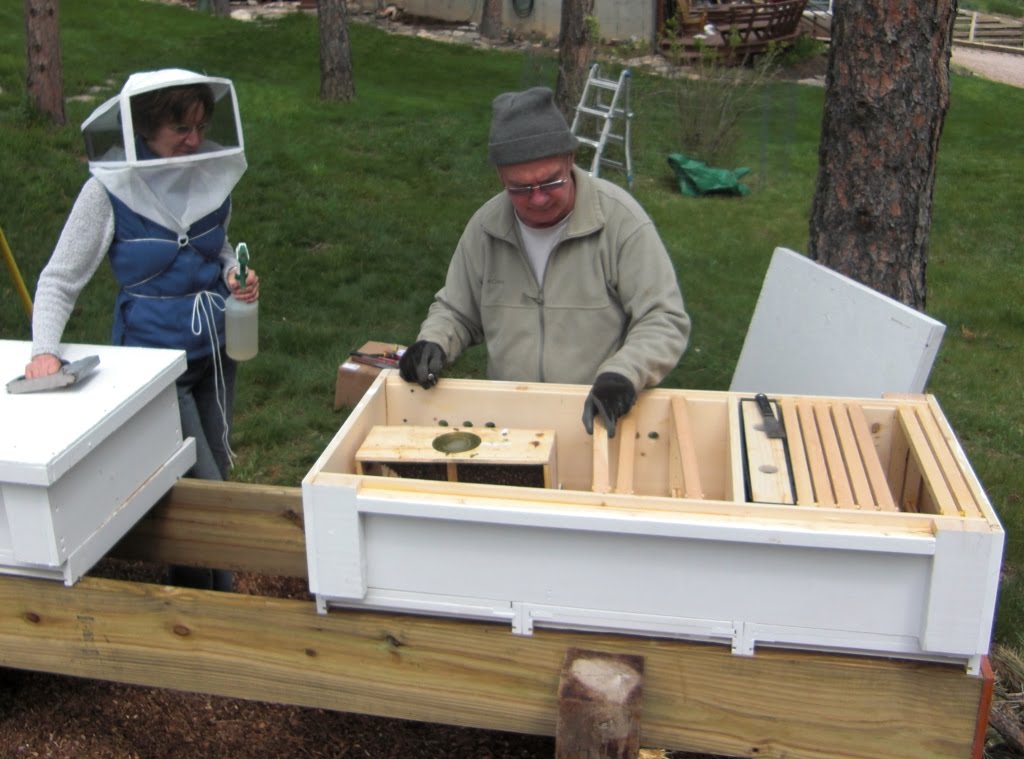
I designed and built two modified top bar hives. Meanwhile, two colonies arrived via the mail.
Too bad some things went awry. First, when the bee supplier called to say they were behind on shipping, I said "fine," not knowing they already had the bees packed, but they just sat there in the Georgia warehouse. When the bees arrived, their was no more food, the bees were badly stressed, and I am not sure one of the queens survived.
Then, despite request the post office call me when the bees came in, I arrived home to discover the bees had been waiting all day without food.
So we rushed the hives out to the yard and installed the bees. Same as last year's installation of a new colony...first move the queen's chamber to the new hive, then shake the livin daylights out of the bees in the inverted shipping box. Oddly, I still did not get stung this year even though I shook and banged on their shipping box.
Let's hope these ladies thrive in their new forest home.
Lee's Bee's at www.Leez.Bz
Honey bees get a bad rap. Most barefoot and front-porch stings are from those mean and nasty wasps. Honey bees are fuzzy-cuddly folks. They go out of their way to avoid conflicts.
Honey bees are also beautiful, delicate, interesting, and extremely well-engineered. See the long, flexible tongue-like proboscus on one lady, used for collecting nectar and pollen. See the backward-facing toe claw on the front foot, and the opposing front-facing claw on the middle foot? And there appears to be two claws on the real leg. And those EYES! All the better to find stuff with, I guess. If you click on any of these photo's they show in much more detail.
Any how, enjoy the fuzzy little girls. By the way, these models were from two colonies we installed just yesterday. See the next post about that story.
Lee's Bee's at www.Leez.Bz
 Opened the hive today for spring inspection. Here is what we saw. Notice the lady laden with ample pollen.
Nolan Alley invited me to his home for grandfather-training. Nolan's parents, Stacy and Paul are already trained and handling their parental duties in stellar fashion.
 Lee stopped by Bearizona, Arizona to visit Bearizona's Chief Operating Officer Vanessa and her husband Patrick, and their eldest son. Bearizona intends to open in late May (this year!). I met Sean Casey, the owner-developer, who is a great young man. I also met a couple newborn baby bears that Vanessa is introducing to the Park. These cubs feel, at the same time, wild and dangerous, and dependent and vulnerable. Whew!
If the bees can start with last year's beeswax honeycomb, start warehousing honey first thing in the spring, then they are more likely to produce enough honey to make a sweet-toothed person cry. But we chose the "crush and strain" method, where in we cut out the entire beeswax honeycomb along with the honey in the comb. We then crush and stir it in a food grade white 5-gallon bucket. We then strain the honey, pour it in to Mason jars and seal. The strained-out beeswax is used for candles, lip balm, car-door lubricant, etc.
Went looking for that pesky elusive queen again today. Found larvae, so she must be there somewhere. In the process, found a small few of the special oversized beeswax comb-cells the ladies fabricate to induce drones.
Can you imagine that? These ladies evict and kill redundant males each fall, then in the spring those same ladies just order up some males to date a hive queen.
But, wait. Their queen has already mated once, for life. So what they're doing is creating drones to mate with a just-in-case new queen. ("just-in-case mating males"?)
In case the old queen needs to be "superceded", or in case they have plenty stores to support the natural colony-replication event called "swarming." When the colony swarms (subdivides), the ladies first create a dozen or so new-queen larvae, then the first new queen to emerge and sting the other queen larvae to death (who needs competition for those nice, "pure" drones) leads half of the colony on a pilgrimage to find a new hive home.
What all this sorts down to is this. The 75,000 worker ladies are creating a couple dozen males to compete for mating with a virgin queen, and any male that does will die immediately, while the males that don't will lay around all summer getting fat on the ladies' free honey until they boot the guys out the front door.
Life is tough.